
|
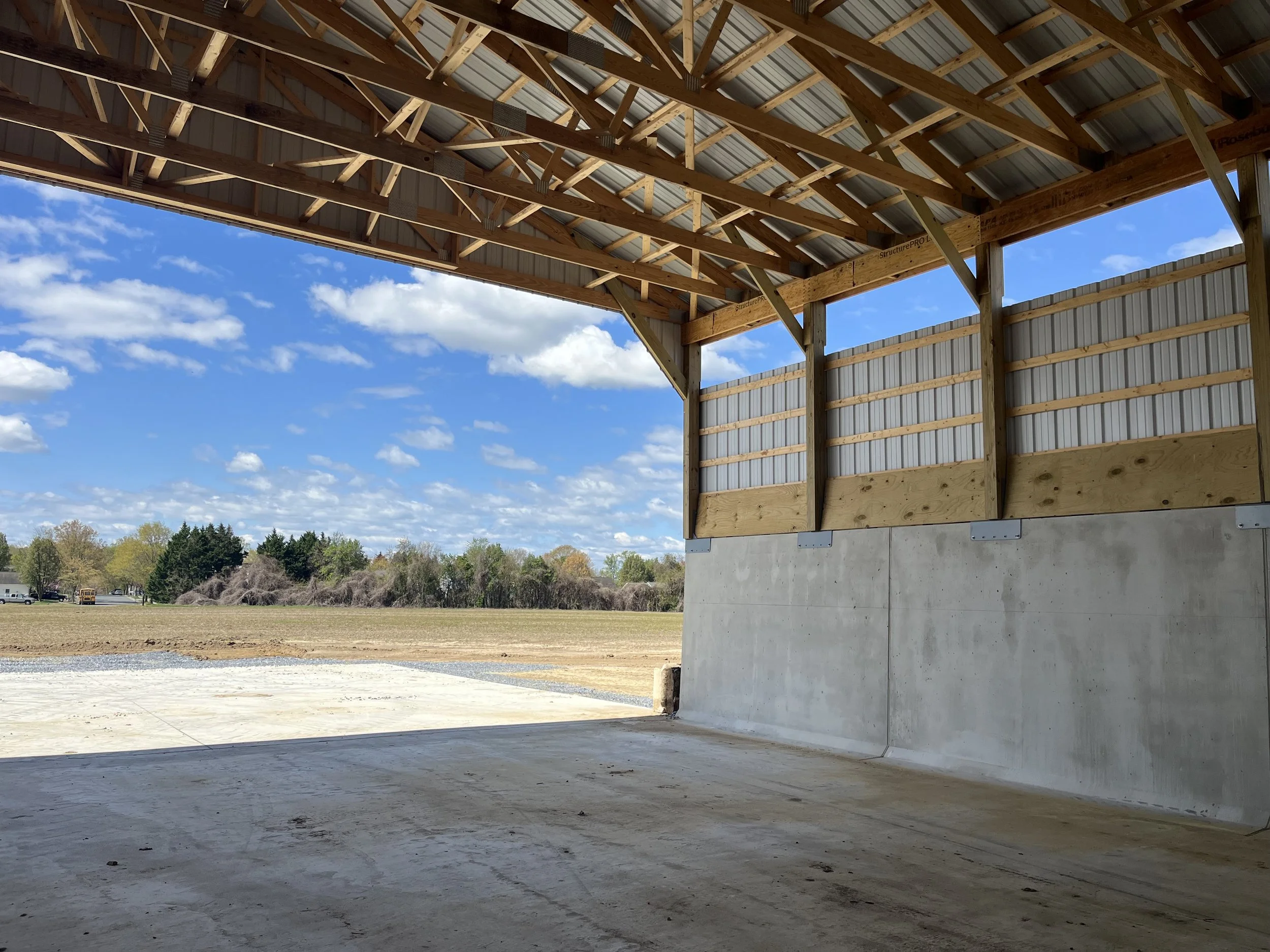
Agricultural structures less than 5,000 square feet are exempt from stormwater management regulations.
For agricultural structures greater than 5,000 square feet but disturbing less than 1 acre, a Standard Plan may be used for the project.
Please note that Erosion and Sediment Control approval may also be required. Applicants are encouraged to consult with Talbot SCD staff before beginning the submission process.
Talbot SCD staff are also responsible for conducting annual maintenance compliance checks on all approved agricultural structures.
|
The Code of Maryland Regulations (COMAR 26.17.02) requires that an approved stormwater management plan be obtained for any land development or construction activity that disturbs 5,000 square feet or more. A standard plan is designed to address stormwater runoff from individual or contiguous agricultural structures and associated grading and improvements within a single limit of disturbance (LOD). Where there are multiple structures and areas of disturbance that are not contiguous, individual standard plans or an approved Soil Conservation and Water Quality Plan (SCWQP) may be used to address stormwater management requirements. Existing development does not need to be included in the application of this standard plan if it is not part of the same project or land disturbance or if stormwater management has been addressed. The requirements for stormwater management found in COMAR 26.17.02 will be satisfied if the Limitations, Conditions, and Construction requirements specified below are met for the construction covered under this standard plan.
LIMITATIONS
A standard stormwater management plan may be used for the construction of agricultural structures and associated grading and improvements if all of the following limitations are met:
The intended use of the structure is in connection with implementing agricultural land management practices as defined in COMAR 26.17.02. This includes the storage and basic processing of products produced on the farm where the structure(s) is located, and livestock propagation. Basic processing includes the cutting, drying, and packaging necessary to store and use on the farm as well as market farm products.
The agricultural structure is not to be used for human occupancy or be open to the general public for commercial, recreational, or other uses.
The agricultural structure and associated grading and improvements will not cause flooding of adjacent property, structures, or roadways.
The construction activity is not part of a larger common plan of development, unless covered under an approved Soil Conservation and Water Quality Plan, where multiple separate and distinct construction activities are occurring under one project (e.g., drawing, permit application, or zoning request) indicating that multiple activities may occur on the property.
No more than 1 acre (43,560 square feet) of earth will be disturbed during construction.
No disturbance or construction shall occur within 100 feet of any perennial stream, water body, tidal wetland, or mean high water line to tidal waters.
CONDITIONS
Stormwater management shall be addressed for all impervious areas within the LOD. ESD shall be used to the MEP to treat runoff according to Chapter 5 of the Manual.
To the extent practical, all impervious areas shall drain and discharge continuously through vegetation in a non-erosive manner. The length of the vegetation shall be at least equal to the length of the contributing impervious area. Concentrated runoff should be avoided.
A 3- to 5-foot wide splash strip shall be provided around any structure built without gutters and downspouts to prevent erosion. Structures built with gutters and downspouts shall sheet flow in a non-erosive manner continuously through at least 60 feet (Eastern Shore) or 75 feet (Western Shore) of vegetation unless an additional environmental site design (ESD) practice is used as specified in the 2000 Maryland Stormwater Design Manual (Manual).
Vegetated areas used for filtering runoff shall have a slope no greater than 5% and be permanently stabilized using an appropriate Natural Resources Conservation Service (NRCS) Conservation Practice (e.g., 332 – Buffer Strips, 342 – Critical Area Planting, 393 – Filter Strip, etc.) or another method specified by the local Soil Conservation District.
Access roads shall be no wider than 15 feet and be graded such that sheet flow is established. Any road swales or ditches shall be properly stabilized and sized to accommodate the drainage area to them.
ESD practices may be used in lieu of the required vegetation lengths provided they are designed according to the Manual.
Compliance must be demonstrated for all federal, State, and local requirements. This includes, but is not limited to erosion and sediment control, Critical Area, Forest Conservation, Wetland and Waterways, local zoning, off-site flooding restrictions, concentrated animal feeding operations, etc.
The Talbot Soil Conservation District or appropriate enforcement authority shall have access to the property for inspection purposes.
A sketch plan shall be submitted indicating property lines, road frontages, the location and size of existing and proposed structures (e.g., barn, access road, storage sheds, etc.), the location of all waters of the State (Critical Area buffer, tidal wetlands, perennial streams, open water, etc.), limits of disturbance, direction of surface flow, any erosion and sediment controls necessary to prevent off-site sedimentation, and any other information specified by the appropriate approval authority.
Operation and maintenance of all stormwater management practices included in this standard plan shall be assured in perpetuity.
CONSTRUCTION
The applicant shall notify the Talbot Soil Conservation District at least 48 hours prior to starting site work.
Off-site tracking of sediment or sediment-laden discharges are strictly prohibited.
All erosion and sediment control practices necessary to control runoff during construction shall be installed and maintained according to the criteria contained in the most recent version of the Maryland Standards and Specifications for Soil Erosion and Sediment Control.
Following initial soil disturbance or re-disturbance, permanent or temporary stabilization shall be completed within three (3) calendar days on the surface areas of all sediment controls, stockpiles, and perimeter slopes; and seven (7) calendar days for all other disturbed areas on the site not being actively graded.
All stormwater management practices, or runoff controls shall be installed and maintained according to this Standard Plan and the Manual. Any alteration or modification of these practices requires the approval of the Talbot Soil Conservation District.
Access to the site will be made available at all reasonable times during construction and with reasonablenotification after construction for inspection by the Talbot Soil Conservation District.
The applicant shall promptly repair or restore all sediment control and stormwater practices found to be innoncompliance.
The Talbot Soil Conservation District reserves the right to deny approval under this Standard Plan and require thata design be prepared according to the Talbot County Government, Public Works Department and the Manual.
Coverage under this Standard Plan shall remain valid for three (3) years from the date of approval.
|
Complete the form below to submit an Agricultural Stormwater Management Plan to the Talbot Soil Conservation District for review.
Please note: Talbot SCD must receive the required $200 review fee before the plan can be approved.
|
Standard Plan - PDF Fillable
|
$200.00 per plan, which covers 5,000 sf to 1 acre (43,560 sf).
Check can be made payable to Talbot Soil Conservation District.