
|
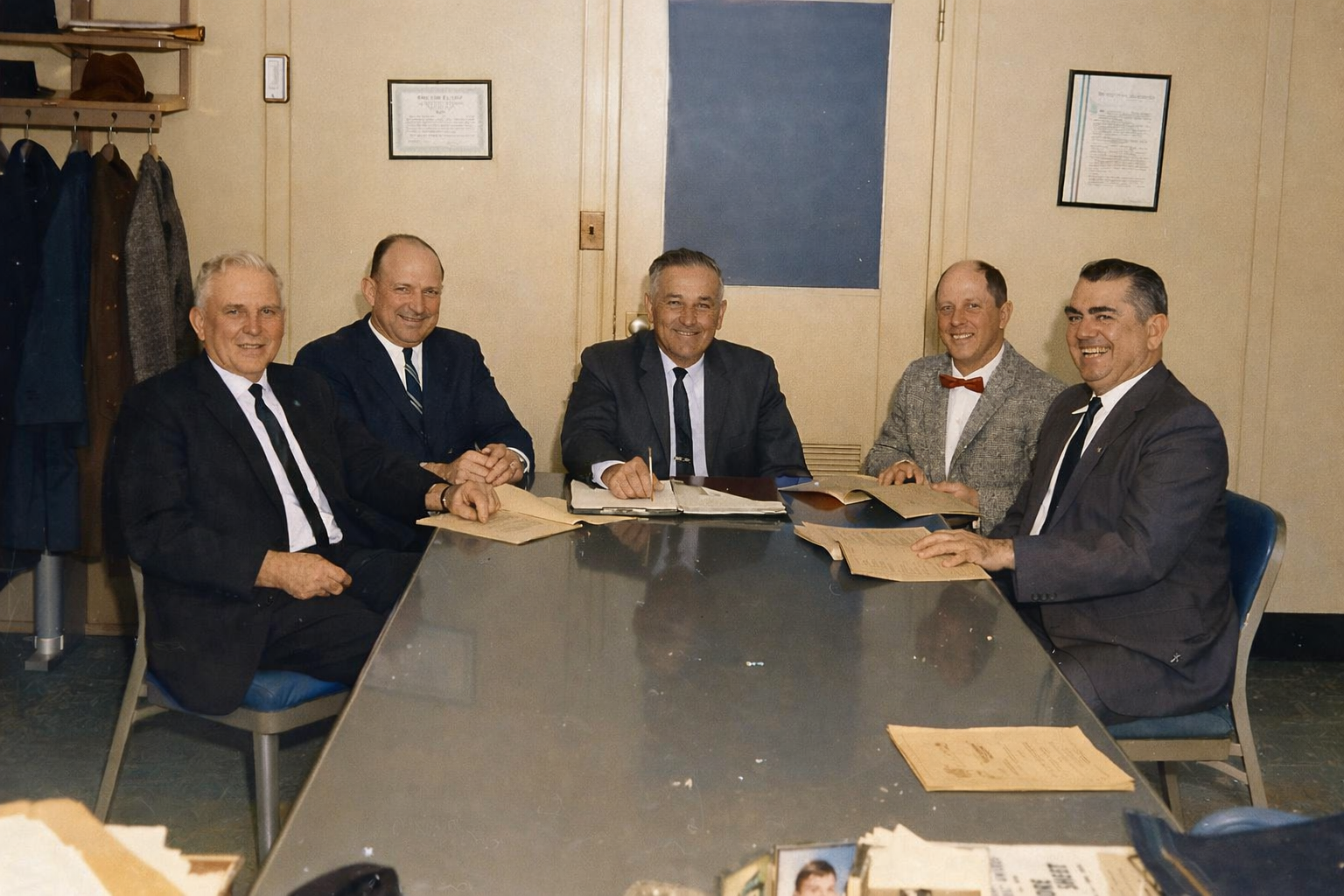
Early Talbot SCD Board - Left to right: Earl Hutchison, Bill Sharp, Norman Fike, Donald Bridges and Eugene Schwaninger.
The old proverb, “all things come to those who wait,” could not be more appropriate when telling the story of the Talbot Soil Conservation District. Its creation was not the result of a single meeting or a quick vote, but rather a long and determined effort that unfolded over more than a decade. What finally came to fruition in 1958 was the product of persistence, changing leadership, and a growing recognition that Talbot County’s farmers needed local conservation support.
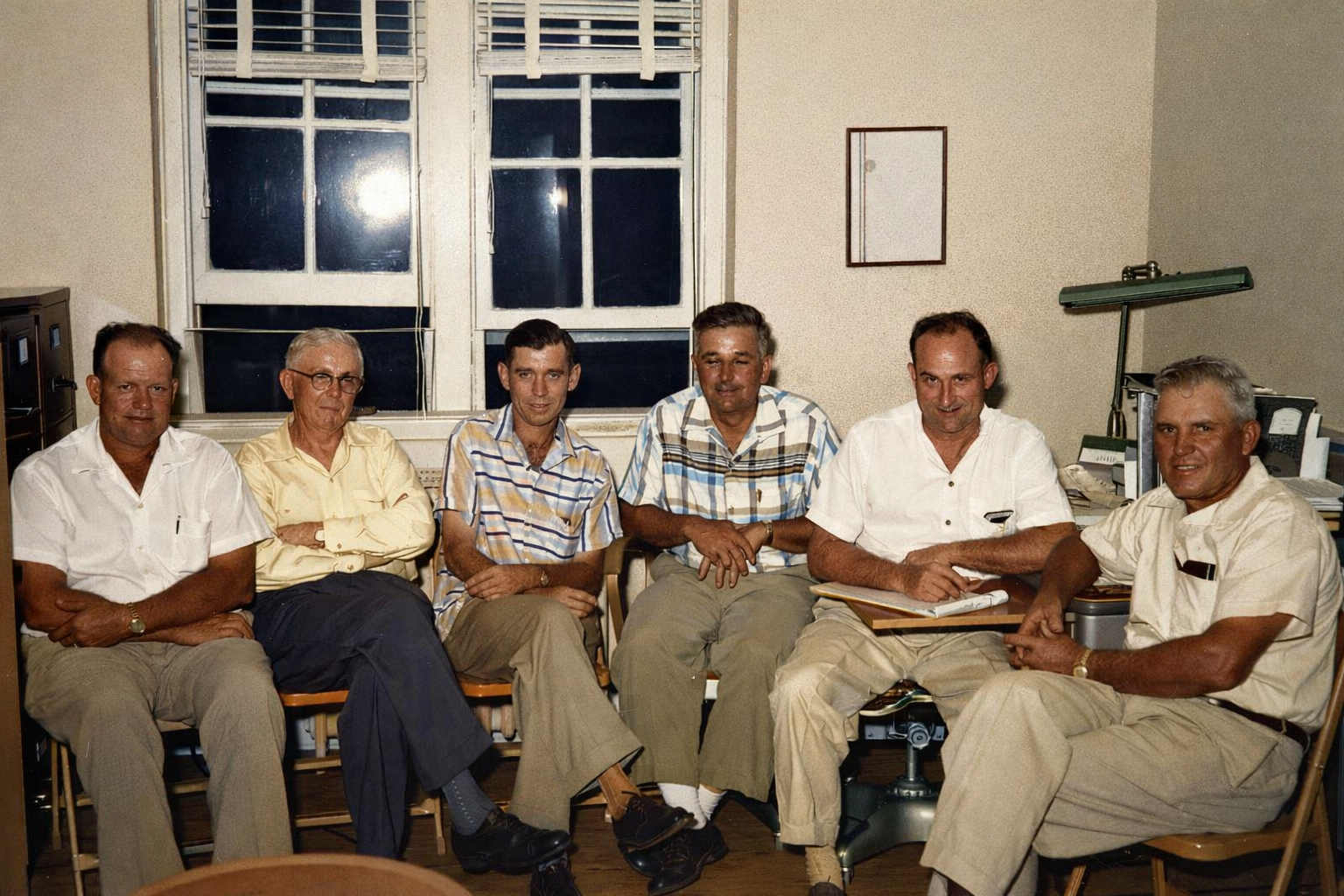
From left to right: Sidney Mielke, Graham Price, Marion Bryon, Norman Fike, Roscoe Brown and Earl Hutchison.
From late 1945 through early 1958, several attempts were made to establish a Soil Conservation District in Talbot County, but each effort initially fell short. The main obstacle was not opposition so much as a lack of widespread interest from enough of the farming community to move the idea forward. The first serious push came in 1945, when approximately 1,200 notice cards were distributed across the county inviting farmers to attend a series of public hearings on the question of forming a district. On paper, it was a strong outreach effort. In practice, however, turnout was disappointing. Only 35 farmers attended the four meetings combined: 9 in the St. Michaels Bay Hundred District, 15 in Cordova, 4 in Easton, and 7 in Trappe. While those who did attend were generally supportive, the numbers simply were not there to create the momentum needed to establish a district. The County Extension Agricultural Agent, who had been charged with organizing the hearings, was unable to generate the level of countywide interest required, and the effort gradually lost steam.
Even so, the idea never completely disappeared. Over the years that followed, state leaders continued to push for Talbot County to join the rest of Maryland in forming its own district. One of the most persistent voices was T.B. Symons, Dean and Director of the University of Maryland, who recognized both the practical need and the larger importance of completing Maryland’s statewide conservation framework. Dr. Symons reportedly received repeated calls from Talbot County farmers seeking help with surface drainage problems—so much so that some were looking outside the county for assistance from neighboring districts. Those requests made it clear that, regardless of public hesitation, local landowners were dealing with real and ongoing resource concerns. Correspondence between Dr. Symons and Rudolph Brown, the County Agricultural Agent at the time, reflects just how committed state leadership was to seeing Talbot County become the final piece of Maryland’s Soil Conservation District system.
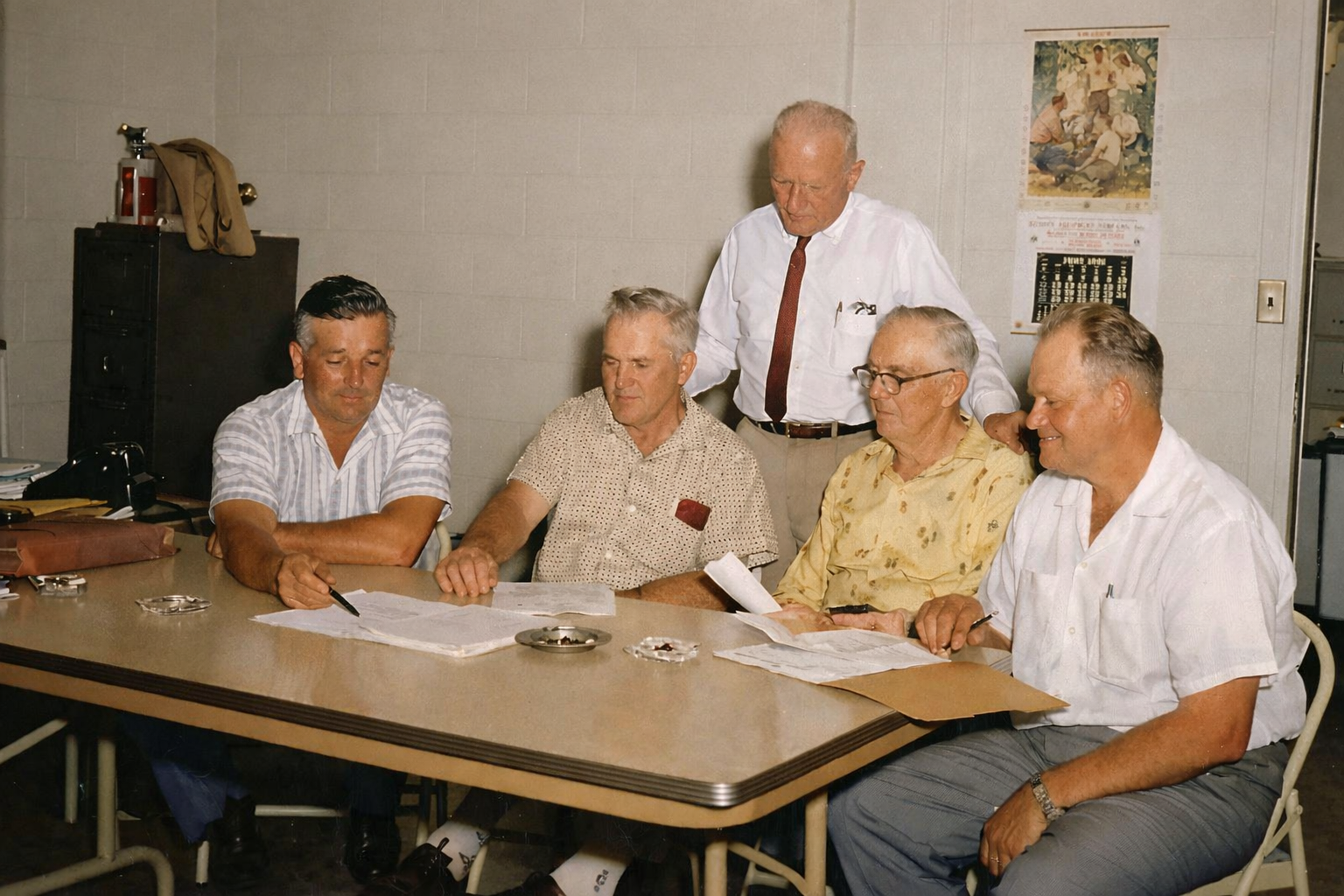
Talbot SCD Board in 1961- left to right: Norman Fike, Earl Hutchison, unknown, Graham Price and Sidney Mielke.
At the heart of the issue was surface drainage. For many Talbot County farmers in the 1940s and 1950s, drainage was the most pressing land management concern. Fields that held water too long could delay planting, reduce crop yields, and make farming more difficult overall. In his editorials, Mr. Rudolph Brown noted that the “Extension Service Drainage Engineer” had handled drainage-related concerns through his office for years. Because that service was already available, many farmers may have felt that a separate Soil Conservation District was unnecessary. Some likely viewed drainage needs as something that could continue to be addressed through older, familiar systems such as local Tax Ditches, rather than through a broader conservation structure. Mr. Brown himself was not an advocate for forming the district and was known to be openly critical of the idea. His position almost certainly shaped public opinion and contributed to the difficulty in building stronger support during those early years.

The true turning point came around 1955, when Rudolph Brown left the Extension Service. His replacement, Roscoe Brown—no relation—brought a different outlook and a renewed willingness to put in the time and effort needed to organize meetings, build interest, and encourage participation among farmers. That change in leadership appears to have made all the difference. With a more supportive County Agent, and with the continued encouragement of state conservation leaders, the final push to form the district gained traction.
That persistence paid off on April 15, 1958, when Talbot County held a countywide vote on whether to establish a Soil Conservation District. This time, the outcome was clear: 184 votes in favor and 107 opposed. After years of false starts, the measure finally passed.
With that vote, Talbot County made history. The Talbot Soil Conservation District became the 24th and final Soil Conservation District established in the State of Maryland, completing the statewide network created to provide locally led conservation assistance to farmers and landowners. What had once been a difficult and uncertain effort ultimately became an important milestone—not only for Talbot County, but for conservation in Maryland as a whole.
That long journey makes the District’s anniversary even more meaningful. On April 15, 2026, the Talbot Soil Conservation District will proudly celebrate 68 years of service. Since its founding, the District has continued the mission first envisioned decades ago: providing technical assistance, conservation planning, and natural resource support to Talbot County’s agricultural landowners and farmers. What began as a hard-fought idea has grown into a lasting local institution—one rooted in service, stewardship, and the belief that conservation works best when it is led by the community it serves.